Seattle Bouldering Project Started With Two Guys Jumping Off a Staircase. It's Now a National Chain.
Fourteen years after two founders tested their own foam floor by leaping off a warehouse staircase, the company they started runs thirteen gyms in eight states, with Seattle's colorful Fremont walls still tracing back to a Central District original.
From a Warehouse Floor Test to Eight States
In the spring of 2011, Andy Wyatt and Chris Potts filled two empty rooms of a Central District warehouse with as many climbing walls and boulder problems as they could build, then tested whether the foam floor would actually catch a fall by leaping off the gym's own staircase. That warehouse became Seattle Bouldering Project. Fourteen years later, the company Wyatt and Potts started by throwing themselves at their own flooring runs thirteen gyms across eight metro areas, and Seattle is still where the walls get designed. Two of those gyms sit one block apart in Fremont, painted in the teal, green, and navy that has become the brand's signature, and they are the reason most Seattlites think of Fremont, not the Central District, when they hear the name. That's a small mix-up worth clearing up, because the real story is bigger than either building. A gym born from two people testing their own foam floor now has outposts in Austin, Minneapolis, Salt Lake City, Brooklyn, Boston, Washington DC, and Tempe. None of that happened by accident, and Fremont's colorful walls are as good a place as any to see what a hometown company looks like after it stops being small.
The Original Is in the Central District, Not Fremont
The founding gym, now known as Poplar, still stands at 900 Poplar Pl S, in an ex-warehouse overlooking I-90 that has since grown a yoga studio, a cafe, and a full weight room around its original bouldering walls. Fremont and Upper Walls came later, as Seattle Bouldering Project expanded within its own city before it ever left Washington. The company's own website puts it plainly: this is where Bouldering Project got its start, calling Seattle its hometown and the place it found its groove designing walls and building community. Three Seattle locations exist today, Poplar, Fremont/Upper Walls, and University District, and a single membership moves between all of them.
Two Buildings, One Block, All Color
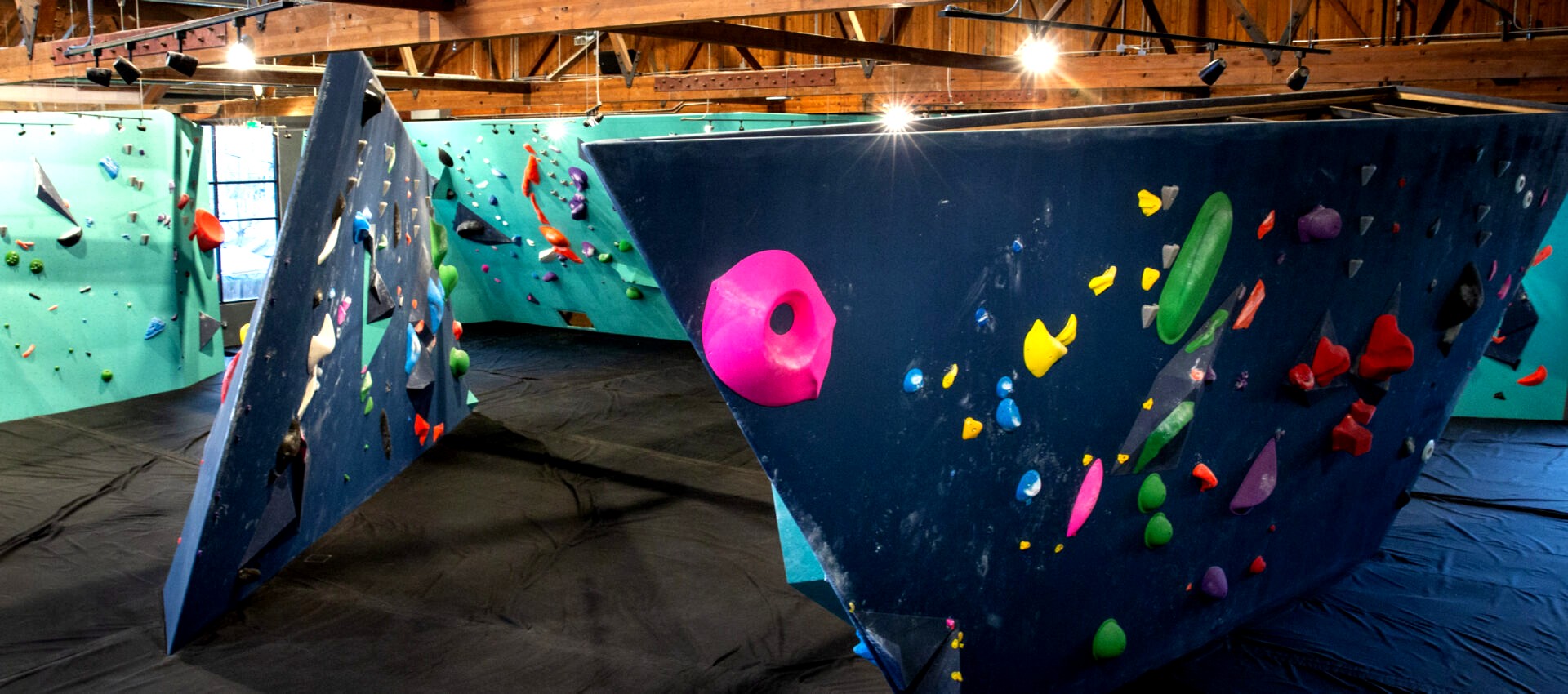
Fremont sits at 3535 Interlake Ave N, and Upper Walls sits one block north at 3625 Interlake Ave N, close enough that the walk between them runs about sixty seconds. Fremont carries the bigger footprint and the neighborhood's flair, a bright two-floor space combining bouldering, fitness, and co-working under one roof. Upper Walls is smaller and more focused, a dedicated bouldering and training space tucked into the block behind it. Fremont is open weekdays from 6 a.m. to 10 p.m. and weekends from 7 a.m. to 10 p.m., while Upper Walls runs 9 a.m. to 9 p.m. every day. The teal and green walls, hung with fluorescent pink, yellow, and orange holds, are less a design choice than a way of making an industrial building feel like it belongs to the neighborhood outside it.
More Than a Wall
None of the three Seattle gyms sells bouldering alone. Fremont and Upper Walls both run a dedicated yoga studio with a full class schedule, a functional fitness space stocked with free weights and racks, and a gear shop for anyone who shows up without shoes or chalk. Co-working spaces round out the building, turning a climbing gym into somewhere a member might reasonably spend an entire workday, not just an hour on the wall. First-timers can rent shoes at the desk rather than buy a pair before they know if the sport sticks, a small detail that keeps the barrier to a first visit low.
From Seattle to Eight States
Growth came fast after that first warehouse. Austin was the second location, opened by the same founders, followed by Minneapolis before the original ownership group sold the company during the pandemic. The new owner kept building, adding Brooklyn, Boston, Dallas, Salt Lake City, and Washington DC before opening in Tempe, Arizona. Thirteen gyms now carry the Bouldering Project name, and every one of them traces back to two people testing a foam floor in a Central District warehouse that had nothing in it yet. Seattle's three locations remain the company's proof of concept, the market where a design gets tried before it ships anywhere else.
What It Costs to Climb Here
A single membership at any Seattle location runs $105 a month for adults 21 and up, with a one-time $55 activation fee. Younger climbers pay less: $95 a month for ages 14 to 20, and $75 a month for 13 and under, both carrying the same activation fee. Members can freeze a membership for $10 a month during a slow stretch, or cancel with no fee attached through the gym's online request process, a friendlier policy than most gyms offer. Day passes and ten-visit punch cards exist for anyone who wants to try the walls before committing to a monthly rate.
The Walls That Started It
This fall's Bouldering League runs out of the University District gym, from the week of September 29 through October 30, open to any member with access across all three Seattle locations, Fremont included. It is a small, ongoing reminder that Seattle Bouldering Project never stopped being a local company, even after its name showed up in eight states. The staircase Wyatt and Potts jumped from in 2011 is long gone, replaced by three buildings' worth of teal and navy walls loaded with color, but the instinct behind it, test it yourself before asking anyone else to trust it, still shapes every gym the company opens.